South Carolina Financial Literacy Standards
According to the American Public Education Foundation (APEF), South Carolina receives a grade of “B” in terms of its financial literacy standards for schools as of September 2025. The APEF publishes a report every two years titled “The Nation’s Report Card on Financial Literacy.” This analysis assigns a grade to every U.S. state, DC, and Puerto Rico based on their current guidelines in place for personal finance education.
South Carolina earns the “B,” according to the APEF, because the state began requiring a financial literacy course for high school students in 2005 when the legislature adopted the Financial Literacy Instruction Act (Act No. 38; House Bill 3020). This policy requires school districts to implement “a program of instruction on financial literacy within courses currently offered in high schools in this State.” Students could comply with the mandate by taking one of two optional courses available within the Human Services Cluster, Financial Fitness 1 and Financial Fitness 2. The APEF considers the standards for these courses to be robust. The South Carolina Legislature expanded on this requirement in 2022, directing the state Department of Education to update graduation requirements to include a semester-long personal finance class.
The Palmetto State falls short of earning an “A” grade from the APEF, however, because there are no standards for K-8 except in second grade. K-8 benchmarks that ensure foundational financial literacy learning at each grade level are needed before the state meets the A-ranking criteria.
SC Financial Education Standards by Grade Level
South Carolina sets forth the standards for the required high school personal finance course as follows: “Using experiential activities, students will learn the basic principles of personal finance and how to manage their money in a global economy, which include budgeting, banking, insurance, mortgages, savings, investments, inheritance, retirement, tax, and estate planning. Students will also learn about consumer protection laws, internet safety, and cyber security, enabling them to safeguard financial information against technology-based attacks.”
The Palmetto State has no financial education standards embedded in the Social Studies College- and Career-Ready Standards for K-8 levels – except for 2nd grade, where the concepts can be found in the Economic strand.
The Financial Literacy Instruction Act did include a requirement for the South Carolina Department of Education to create and maintain a Financial Literacy webpage that includes curricula, instructional materials, and personal finance resources. The State Treasurer’s Office also provides various resources through its Future Scholar 529 program that support financial literacy – including teacher incentives for financial literacy education, elementary lessons and activities, and summer reading lists.

Recommended Policy for SC Financial Literacy Programs
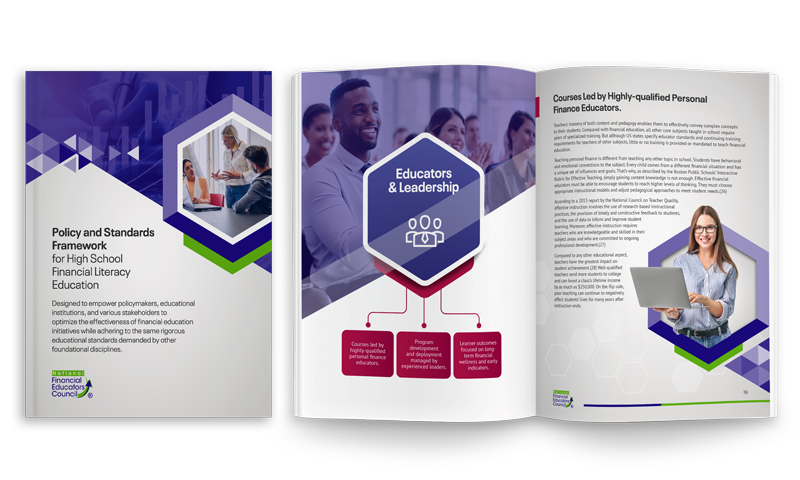
To address the gap in standards for personal finance education, the National Financial Educators Council has developed a set of benchmarks for all grade levels, K-12. This policy guide offers legislators a framework that standardizes educational quality and learner outcomes to provide the best possible financial education for American youth.
The Standards Guide is based on the notion that financial education should be treated with the same rigor as any other topic taught in schools and that all students should be capable – at minimum – of making near-term financial decisions.
National Standards for Financial Education
Financial Literacy Standards for Older Youth & Adults (High School through Adults)
Although there is no direct mandate by the South Carolina State Board of Education, it is recommended that national standards be implemented. Financial education is a unique subject; all participants have developed financial habits and relationships with money before instruction begins.
National standards are those that have been proven in empirical and theoretical research to produce the highest improvements in participant test scores.

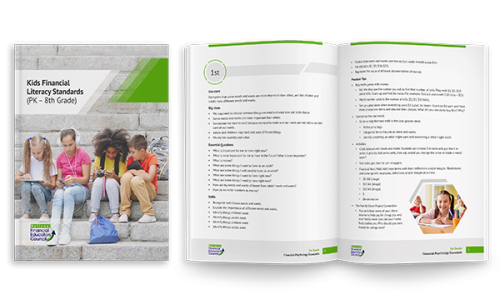
Financial Literacy Standards for Kids (Kids PK through 8th Grade)
In collaboration with education leader Heidi Jacobs, the NFEC created these financial literacy standards to define learning goals and educational targets for optimal child financial education. Guided by strong pedagogical theory, the standards ensure that instructional targets are age- and developmentally-appropriate and that lessons can be effectively scaffolded. Standards represent five sections based on topic areas in the NFEC curriculum.

Standards for Financial Education Instructors
The NFEC teamed with the well-known Danielson Group to develop the first and only national standards for financial educators – The Framework for Teaching Personal Finance – to define optimal educator skill sets and performance levels. The framework also identifies the financial educator responsibilities empirically proven to produce highest gains in participant test scores. This framework is used in all 50 states, including South Carolina.